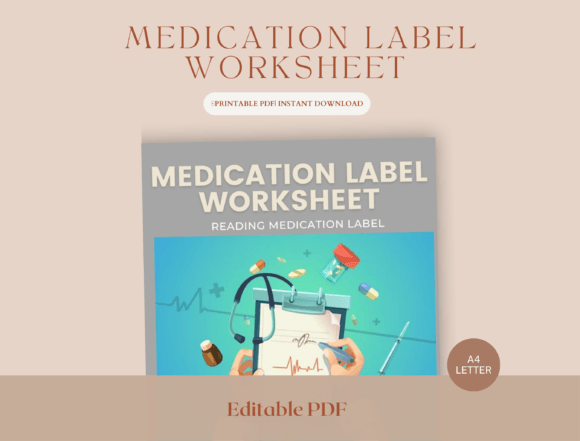
Printable Medication Label Worksheet: Stay Organized and Safe
If you’ve ever stared at a pill bottle and wondered, “Did I take my morning dose or not?” you’re not alone. Managing medications—whether for yourself, a family member, or a client—can quickly become overwhelming when you’re juggling multiple prescriptions, over-the-counter remedies, and a busy schedule. That’s where a medication label worksheet printable comes in. This simple but powerful tool helps you record, review, and track every detail about your medications in one place. Instead of relying on memory or scattered sticky notes, you get a structured document that mimics the format of a real prescription label, complete with sections for the drug name, dosage, frequency, and special instructions. Let’s explore why this printable is worth your time and how it can make a real difference in your daily medication routine.
What Makes a Medication Label Worksheet Printable So Useful?
At its core, a medication label worksheet printable is designed to bridge the gap between the information on a prescription bottle and your personal understanding of it. Most people skim over the fine print on a label—until a question comes up during a doctor’s visit or in an emergency. With a worksheet, you actively transfer that data into a format you can study, share, and update. The key characteristics that set a high-quality worksheet apart include its use of a real prescription label as a visual example, a set of targeted questions that test your comprehension, and an editable layout so you can customize it for different scenarios.
A Prescription Label Example That Grounds the Learning
One of the most valuable features of a well-designed medication label worksheet printable is that it includes a sample prescription label. This isn’t just a generic placeholder—it’s a realistic replica showing a patient name, drug name (like Lisinopril 10 mg), dosage instructions (“Take one tablet by mouth daily”), pharmacy details, and warning stickers. By examining this example, you learn exactly where to find critical details on your own bottles. For a caregiver or a health educator, this sample becomes a teaching aid: you can point to the label and say, “See here? That’s the strength. And this note says ‘Avoid grapefruit.’” The example transforms abstract text into a concrete reference.
Nine Targeted Questions with Blank Spaces for Answers
What truly gives a medication label worksheet printable its power is the set of nine carefully chosen questions that follow the example. Each question corresponds to a specific piece of information on the label. For instance, you might see:
- What is the name of the medication?
- What is the dosage strength?
- How often should this medication be taken?
- What is the route of administration (e.g., by mouth, topical)?
- What is the prescription number?
- Who prescribed this medication?
- What is the expiration date?
- Are there any special warnings or instructions?
- What is the pharmacy’s contact information?
Each question leaves a blank line for the user to write their answer. This format forces active recall—you’re not just passively reading; you’re finding the data and writing it down. The physical act of writing helps cement the information in memory. For a parent teaching a teenager about their allergy medication, or for a home health aide onboarding a new patient, these nine questions turn a routine check into a mini-lesson in health literacy.
An Answer Key for Self-Correction
No worksheet is complete without a way to verify your responses. The answer key provided alongside the medication label worksheet printable lists the correct information from the example label. This turns the exercise into a self‑assessment tool. You can work through the questions, then check your answers to see if you misinterpreted any part of the label. Did you read “once daily” as “twice daily”? Did you miss the warning about drowsiness? The answer key catches those mistakes before they affect your medication adherence. For educators using the worksheet in a classroom or a workshop, the answer key also doubles as a grading rubric—simple but effective.
Practical Applications Across Different Environments
The beauty of a medication label worksheet printable lies in its versatility. Whether you’re a busy professional managing your own health, a freelance writer creating content for a health blog, or a small business owner training staff on medication safety, this worksheet adapts to your context.
Personal Use: Building Confidence and Routine
For individuals taking multiple medications, the worksheet serves as a personal medication record. Print one copy per drug and fill it out. Keep the completed sheets in a folder or a binder that goes to every doctor’s appointment. When the pharmacist asks, “Are you still taking the 5 mg or the 10 mg?” you can flip to the relevant page and know immediately. This reduces errors and gives you confidence in discussing your treatment plan. I recommend laminating or placing the sheets in plastic sleeves so they stay clean in a medicine cabinet or a purse.
Caregivers and Family Health Managers
If you oversee medications for a parent, a spouse, or a child, the medication label worksheet printable becomes a shared communication tool. Fill out the sheets together with the person you care for, or keep a separate set for each family member. The nine questions ensure that nothing is overlooked—like checking the expiration date or noting a recent change in dosage. In a household where multiple people take different drugs, color-coding the worksheets (e.g., blue for Mom, green for Dad) prevents mix‑ups.
Healthcare and Educational Settings
Nurses, pharmacists, and health educators often use medication label worksheet printable materials to teach patients. In a diabetes management class, for example, the instructor can distribute the worksheet with a sample insulin label. Patients fill out the questions, then review the answer key together. This hands-on exercise improves health literacy far more than a lecture. Freelance health writers and bloggers can also embed a downloadable version of the worksheet in their articles—readers appreciate a practical takeaway that complements the written advice.
Digital and Client-Facing Use
Even if you work primarily in a digital environment—as a marketer creating a patient education campaign, or as a product designer building a health app—a medication label worksheet printable can be repurposed as a wireframe or a usability test document. It’s a proven layout for displaying structured health information. I’ve seen entrepreneurs offer editable worksheet templates as a lead magnet on their websites; the high perceived value (clear, professional, and immediately useful) drives sign-ups without sounding salesy.
Notable Qualities: Editable, Customizable, and User-Friendly
A standout feature of the best medication label worksheet printable is that it’s editable. This means you can type directly into the blanks using your computer, then print the filled‑in version, or you can manually write on the sheet after printing. Being editable allows you to reuse the template for new prescriptions without starting from scratch. It also means you can adjust the layout—for instance, adding a column for the prescribing doctor’s phone number or the pharmacy’s fax number—if your version gives you that flexibility. Many editable PDFs or DOCX files allow you to change the questions themselves, so you can tailor the worksheet to a specific condition (like blood thinners or chemotherapy drugs) or a specific audience (like children using pill‑shaped bubbles).
Usability and Efficiency
Time is precious, and a medication label worksheet printable saves it by giving you a ready‑to‑use structure. Instead of creating a list from scratch, you open the template, fill in the details for each drug, and you’re done. The logical flow of the nine questions—moving from basic identification to specific instructions—mirrors how a real label is organized, so you don’t have to jump around. This efficiency is especially valuable during medication reconciliation visits, where you need to review all active prescriptions in a matter of minutes.
Communication and Engagement
Having a completed worksheet in hand transforms a conversation with a healthcare provider. Instead of fumbling for your phone or trying to recall the dose of your blood pressure pill, you can read directly from the sheet. This speeds up the appointment and leaves room for more meaningful discussion. For a business owner who hosts employee health fairs, providing these worksheets engages staff in their own wellness rather than just handing out brochures. The act of filling out the sheet makes the information personal.
Practical Considerations When Choosing or Using a Medication Label Worksheet Printable
Not every worksheet is created equal. Here are a few observations from experience that can help you select the right one or use it effectively:
- Check the number and relevance of questions. Nine questions is a sweet spot—enough to cover the essentials but not so many that it feels like a chore. Make sure the questions match the types of medications you deal with. For instance, if you manage injectable drugs, you may need a worksheet that includes “route of administration” and “storage instructions.”
- Look for a clear prescription label example. The example should be high‑resolution, easy to read, and free of typos. A blurry or cluttered sample defeats the purpose of teaching label reading.
- Prioritize editability. A true editable format (like a fillable PDF or a Word document) lets you type answers on a computer before printing. This is a lifesaver if your handwriting is hard to read or if you need to produce multiple copies quickly.
- Consider the audience. If you’re using the worksheet with elderly patients, ensure the font size is at least 12 points and the lines are spaced generously. For children, you might want a version with larger blanks and a simpler label example.
- Pair the worksheet with a routine. Don’t fill it out once and forget it. Update the sheet whenever a prescription changes, and take it with you to every pharmacy visit. I keep a master binder with all my worksheets sorted alphabetically by drug name—it takes ten minutes to maintain and saves a lot of stress.
Finally, remember that a medication label worksheet printable is a starting point, not a replacement for professional medical advice. It helps you organize what you already know and spot gaps in your understanding. Use it as a tool to ask better questions—to your doctor, your pharmacist, or yourself. With a little practice, reading a prescription label becomes second nature, and you’ll wonder how you ever managed without that simple sheet of paper.