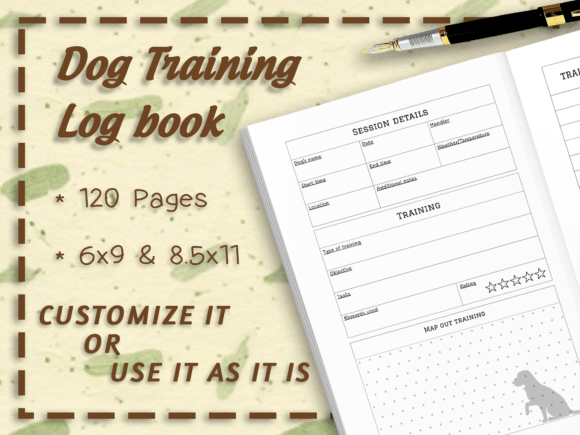
Dog Training Log Book Interior 120p: How a Simple Notebook Can Transform Your Training Sessions and Strengthen the Bond with Every Dog You Work With
Dog training is one of those professions that looks easy from the outside. You show up, you work with a dog, and somehow the magic happens. But anyone who has actually done it knows the truth: it is a mental marathon of observation, timing, and recall. You are not just teaching a dog to sit or stay. You are reading body language, adjusting your energy, noting what triggers a reaction, and keeping track of what worked yesterday versus what fell apart today. And if you work with more than a handful of dogs, the details start to blur. That is where the Dog Training Log Book Interior 120p steps in, not as a complicated system, but as a simple, practical companion that helps you capture the small details before they slip away.
Why Professional Trainers Need More Than Memory
Imagine you have a Thursday packed with four back-to-back sessions. The first dog is a young Labrador who pulls like a sled dog the second he sees another canine. The second is a senior rescue who resource guards his food bowl. The third is a reactive terrier who barks at delivery trucks. And the fourth is a puppy who needs to learn impulse control around visitors. By Friday morning, unless you wrote it down, you are going to mix up which dog flinches at loud noises and which one freezes around strangers. The Dog Training Log Book Interior 120p becomes the one place where you store all of that nuance. You note the environmental triggers, the duration of each exercise, and even the small wins like a loose leash walk that lasted five seconds longer than last week.
For trainers who run group classes, the log book is even more valuable. You might have eight owners and eight dogs in one session. Each dog has a different starting point. One is distracted by the treat pouch. Another is fearful of the clicker sound. Writing down individual progress between rotations means you can give each owner targeted advice without fumbling for names or mixing up behaviors. That kind of specificity builds trust with your clients, and it shows that you are paying attention beyond the surface level.
Not Just for Professionals: How Dedicated Owners Use It at Home
You do not have to be a certified trainer to benefit from structured notes. Many dog owners find themselves stuck in a loop where they try a technique one day, see a glimpse of progress, and then forget exactly what they did by the next session. The Dog Training Log Book Interior 120p is a straightforward way to break that cycle. At home, you can record which reward your dog responded to best, whether it was freeze-dried liver or a squeaky toy. You can note the time of day when your dog is most focused, and you can track how long it takes for a new cue to generalize from the living room to the backyard.
One owner I know used a log book to work through her dog's fear of the vacuum cleaner. She recorded each exposure, how close the vacuum was, and what the dog's body language looked like. Over weeks, she could see that the dog relaxed faster when the vacuum was placed in the hallway before being turned on. That pattern would have been invisible without notes. The log book turned her into a better observer because she had a reason to look closer.
Breeders, Shelter Volunteers, and Daycare Staff: The Overlooked Users
The Dog Training Log Book Interior 120p is not limited to one-on-one training sessions. Breeders who socialize litters of puppies can use it to track temperament development. Which puppy approaches novel objects first? Which one startles at sudden sounds? Having a written record helps match each puppy with the right future home. Shelter volunteers benefit even more. In a busy rescue environment, dogs come and go quickly. A log book dedicated to a single dog's reaction to handling, leash walking, and crate training means that the next volunteer picking up the shift can offer consistency instead of starting from scratch every time.
Dog daycare staff also find unexpected value in a structured log. When a dog has a rough day, maybe they snapped at another dog during playtime, the staff can record what led up to the incident. Was the dog tired? Was there a resource nearby? Over time, patterns emerge, and those patterns allow the daycare to adjust playgroups or rest schedules proactively. The log book becomes a behavioral diary that protects both the dogs and the staff.
Practical Scenarios Where the Log Book Changes the Outcome
Let me walk through a few real-world situations to show how this works in practice. Suppose you are a trainer working with a reactive dog who lunges at bicycles. Week one, you stand fifty feet from a bike path and mark calm behavior. Week two, you move to forty feet. But you forget to write down the wind direction, the speed of the bike, and the dog's arousal level beforehand. Without those notes, you might think the dog regressed when actually the conditions were just harder. A log entry captures those variables, and it stops you from jumping to the wrong conclusion.
Or consider a puppy class where each session builds on the last. If you record which puppies struggled with settling on a mat and which ones mastered it quickly, you can adapt your lesson plans. You might decide to add more duration work for one pup and more distraction proofing for another. The log book helps you teach the dog in front of you, not the dog you assumed would show up.
For owners who train independently, the log book serves as a progress tracker that keeps motivation alive. There will be weeks where it feels like nothing is working. But looking back at entries from two months ago shows that the dog now holds a down stay for thirty seconds instead of five. That concrete evidence of improvement is more powerful than any vague reassurance. It stops people from giving up right before a breakthrough.
What to Consider Before You Start Using a Training Log
Before you dive into the Dog Training Log Book Interior 120p, it helps to think about how you will actually use it. Are you the type of person who fills in notes during the session, or do you prefer to jot down highlights immediately afterward? Some trainers keep the log book open on a table and scribble between repetitions. Others record quick voice memos on their phone and transcribe later. Neither way is wrong, but knowing your style affects how you set up the pages.
Another consideration is consistency. The log book is only as useful as the data you put into it. If you skip entries for three weeks, you lose the thread. That does not mean you need to write a novel every session. Even three bullet points per dog per session can create a valuable timeline. What was the main behavior worked on? What was the biggest challenge? What small win happened? That is enough to keep the story going.
It is also worth noting that a log book like this works best when paired with observation, not rigidity. The pages give you structure, but your job is to notice what the dog is actually communicating. If the log asks for duration of a behavior but the dog is clearly stressed, the honest entry is to note that you stopped early because of stress signals. That kind of honesty in your logs will make you a more responsive trainer.
Strengths and Realistic Limitations
The biggest strength of the Dog Training Log Book Interior 120p is its simplicity. One hundred twenty pages give you room to work with multiple dogs or to go deep on a single dog over time. The two trim sizes mean you can choose a portable version for field work or a larger one for desk use. The PPT files add flexibility if you want to customize categories, change fonts, or redesign the layout to fit your specific training style. That adaptability is rare in pre-made notebooks.
A potential limitation is that no printed log book can anticipate every training method. If you use a very specific protocol, like a behavioral adjustment training plan with lots of numerical thresholds, you might need to supplement the pages with your own notes. But the open-ended design of the log book makes that easy. You can use blank sections for extra notes or modify the PPT version before printing.
Another limitation worth mentioning is that a log book requires physical space and a habit of writing. In a fast-paced session, stopping to write can feel like it interrupts the flow. But most trainers find that the pause is worth it. The act of writing forces you to process what just happened, and that processing strengthens your understanding of the dog.
Who This Log Book Serves Best
The Dog Training Log Book Interior 120p fits a wide range of users, but it truly shines for those who work with dogs regularly and need to track individual differences. Private trainers juggling multiple clients, group class instructors managing a room full of learners, foster volunteers documenting behavior for adoption profiles, and dedicated pet owners working through a specific behavior challenge will all find value in having a dedicated space for their observations.
It also works well for trainers who are building a portfolio of case studies. If you are working toward a certification or simply want to reflect on your own growth, your filled-in log books become a library of experience. Looking back at sessions from a year ago shows you how your timing improved, how your reading of stress signals sharpened, and how your relationship with each dog deepened over time.
At the end of the day, dog training is about connection. The notes you take are not just data points. They are reminders of the moment a shy dog first leaned into your hand, the first time a reactive dog chose to disengage from a trigger, and the patient repetition that turned a confused puppy into a confident learner. A log book holds those moments so you do not forget them. And when you remember them, you become a better trainer for every dog that comes your way.