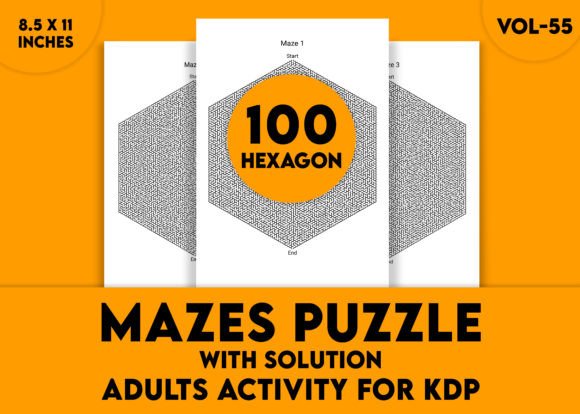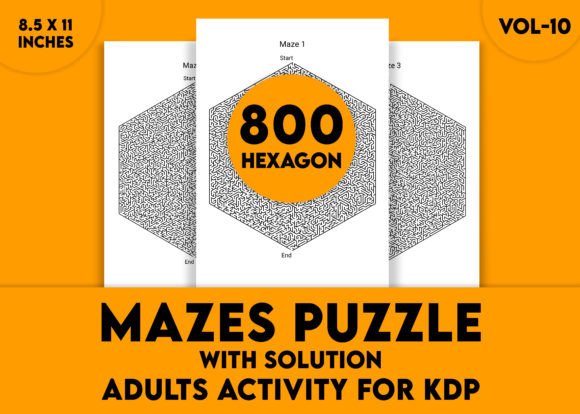
Adults Hard Hexagon Mazes Puzzles Vol-6 – Redefining Problem-Solving Through Hexagonal Labyrinths
Mazes have long served as more than mere pastimes. For adults seeking a genuine cognitive workout, the shift from rectangular grids to hexagonal pathways introduces a new layer of complexity. Adults Hard Hexagon Mazes Puzzles Vol-6 stands out in this domain, offering a collection of 1000 uniquely structured puzzles that demand sustained focus, flexible thinking, and a willingness to navigate non-standard geometry. This volume is designed for those who find conventional mazes too predictable and want a format where every twist, branch, and dead-end feels truly earned.
What Makes Hexagon Mazes Different from Traditional Grid Puzzles
Most maze solvers are familiar with orthogonal grids—right angles, straight corridors, and four possible directions. Hexagon mazes break this pattern entirely. Each cell is a hexagon, providing six possible movement directions instead of four. In Adults Hard Hexagon Mazes Puzzles Vol-6, this geometric shift creates a ripple effect in puzzle design. Paths weave at 60-degree angles, intersections become more ambiguous, and the solver cannot rely on cardinal directions to maintain orientation. The result is a spatial experience that feels closer to navigating a natural landscape than walking the halls of a building.
Furthermore, hexagonal grids allow for loops and branches that feel organic rather than artificially contrived. Because every cell touches up to six neighbors, the maze designer can introduce multiple parallel routes that converge and diverge in ways impossible on a square grid. For the adult solver, this means that backtracking is more frequent, and the map in your head must be updated constantly. The volume explicitly incorporates these features: “various types of twists and turns, multiple branches and loops, and perhaps even some obstacles or barriers” are part of every puzzle.
Volume 6 by the Numbers – What 1000 Hexagon Mazes Entail
A collection of one thousand mazes might sound overwhelming, but the structure of Adults Hard Hexagon Mazes Puzzles Vol-6 makes it manageable and progressive. Each puzzle occupies its own page—the large 8.5x11 inch format ensures that the hexagon grid has enough room to be both intricate and readable. The decision to place one maze per page is deliberate: it gives the solver space to trace paths, make notes, and step back to view the puzzle as a whole without feeling cramped. Solutions are provided at four per page, so checking your work does not require flipping endlessly through a separate section.
The 1000 mazes are not all identical in difficulty. Early puzzles in the volume introduce basic hexagonal movement and simple loops. As you progress, obstacles appear—walls that force detours, barriers that block certain hexagons, and branching structures that require you to remember which paths you have already explored. For adults who want a sustained challenge over weeks or months, this volume provides enough material to build and maintain a solving habit without repetition setting in.
Understanding the 4-Solutions-Per-Page Layout
Efficiency matters when you are working through a large puzzle collection. The solution pages in this volume show four completed mazes, each with the correct path clearly marked. This compact presentation saves paper while still giving you the ability to verify your solution quickly. For educators or hobbyists who use these mazes in group settings, the four-per-page format also makes it easy to display multiple solutions side by side for comparison.
Cognitive Benefits – Why Adults Need Spatial and Logic Workouts
Puzzle solving is often framed as a leisure activity, but the mental processes involved are anything but passive. When you sit down with a hexagon maze from Adults Hard Hexagon Mazes Puzzles Vol-6, you engage several high-level cognitive functions simultaneously. Visual-spatial reasoning is the most obvious: you must track your position relative to the whole maze, anticipate where a path might lead, and mentally rotate the hexagonal grid to maintain orientation. Because hexagons tessellate in ways that create unfamiliar angles, your brain works harder to construct a coherent mental map.
Executive functions also get a workout. Planning a route through a branching hexagon maze requires working memory—you need to remember which branches you have already tried and which remain unexplored. Inhibition is equally important: the urge to follow a promising path must be balanced against the knowledge that it might lead to a dead end. Cognitive flexibility comes into play when your initial strategy fails and you must shift to a new approach, such as solving from the exit backwards or systematically marking visited cells.
- Enhanced problem-solving skills: Repeated practice with non-standard mazes teaches you to break complex problems into smaller, manageable segments.
- Improved concentration and focus: A single hard hexagon maze can demand 20–30 minutes of uninterrupted attention, training your ability to resist distraction.
- Better pattern recognition: Over time, you start to recognize common hexagonal structures (like “cloverleaf” loops or “staggered” dead-ends) and develop intuitive heuristics for solving them.
- Stress relief through immersion: The focused mental state required for maze solving can act as a form of active meditation, lowering anxiety and providing a break from daily pressures.
Real-World Applications – Who Benefits from This Volume
The audience for Adults Hard Hexagon Mazes Puzzles Vol-6 extends far beyond casual puzzle enthusiasts. Understanding the practical uses of these mazes can help you decide whether this volume fits your own needs or the needs of someone you teach or mentor.
Educators and Cognitive Trainers
Teachers of geometry, logic, or design thinking can use hexagon mazes as classroom exercises that bridge abstract concepts with tangible problem-solving. The hexagonal grid naturally introduces topics like tessellation, symmetry, and pathfinding algorithms. For adult education settings such as community college workshops or corporate training sessions on critical thinking, a single maze can spark discussion about planning, adaptability, and learning from mistakes. The editable PDF format of this volume is particularly valuable here: instructors can modify mazes, add annotations, or project them onto a screen for group solving sessions.
Researchers and Hobbyists in Puzzle Design
Anyone who studies puzzle mechanics will find value in analyzing how hexagon mazes generate difficulty. The branching patterns, barrier placements, and loop structures in this volume offer a rich dataset for understanding what makes a maze engaging. Hobbyists who design their own puzzles can use Volume 6 as a reference for how to balance solvability with challenge. The large page size and clear printing also make it easy to trace and replicate specific maze segments for further study.
Professionals Seeking a Structured Mental Break
Software developers, engineers, architects, and data analysts often spend their days solving abstract problems. Adults Hard Hexagon Mazes Puzzles Vol-6 provides a tactile, visual counterpart to those analytical tasks. The physical act of tracing a path on paper—versus clicking through a digital puzzle—can reduce screen fatigue and engage different neural pathways. Professionals report that solving one or two hexagon mazes after work helps them transition out of a high-focus state and into a more relaxed mode of thinking.
Navigating Twists, Branches, Loops, and Obstacles
The description of this volume mentions encountering “various types of twists and turns, multiple branches and loops, and perhaps even some obstacles or barriers.” Let us examine what these elements mean in a hexagonal context and how they shape the solving experience.
- Twists and turns: Unlike the sharp 90-degree corners of square mazes, hexagon mazes feature more gradual directional changes. A “twist” in a hexagonal maze might involve a spiral-like sequence that rotates your orientation. Because you can move in six directions, a path can double back on itself in ways that are harder to predict.
- Multiple branches: In a square grid, a typical branch offers two or three options. In a hexagon maze, a single cell can connect to up to six neighbors, so branches can present four or five viable paths at once. This abundance of choice forces you to develop systematic exploration strategies, such as always turning in a consistent direction or marking each branch with a pencil dot.
- Loops: Loops in hexagon mazes can be large and irregularly shaped. They test your memory: if you enter a loop and traverse it completely, you end up back at the same decision point, potentially wasting time. Skilled solvers learn to recognize loop signatures early and avoid entering them unless necessary.
- Obstacles and barriers: Some hexagon cells in this volume are blocked entirely or have restricted movement through certain edges. These barriers force you to recalculate your route and often turn what seemed like a clear path into a dead end. The presence of obstacles makes the maze feel dynamic, as if the puzzle is responding to your choices.
Practical Tips for Solving Hexagon Mazes Effectively
To get the most out of Adults Hard Hexagon Mazes Puzzles Vol-6, consider adopting techniques that leverage the hexagonal structure rather than fighting it. First, always scan the entire maze before starting. Hexagon grids can hide long corridors that wrap around the page; knowing where the entrance and exit are located relative to the overall shape gives you a strategic advantage. Second, use a pencil with a fine point for tracing tentative paths. The 8.5x11 inch page size gives you room to draw light lines that can be erased later, but a mechanical pencil with 0.5mm lead works best for hexagon cells that are small but distinct.
Third, try solving the maze backward from the exit. This technique is common in square mazes but becomes even more powerful in hexagonal ones because the increased connectivity means that multiple paths converge near the goal. Working backward can reveal which branches are worth pursuing from the start. Fourth, if you encounter a barrier that blocks your chosen route, immediately look for alternative branches two or three steps away rather than retracing every step. The six-directional movement means that a detour of just one hexagon can sometimes bypass an entire blocked section.
The Role of the Editable PDF Feature
One of the standout characteristics of this volume is that it is provided as an editable PDF file. This means you can load the mazes onto a tablet or computer and solve them digitally, using a stylus or drawing tool. For educators, the editable PDF allows you to add instructional annotations, highlight specific hexagons, or create multiple versions of the same maze by shifting barriers. For personal use, solving on a tablet eliminates the need for printing and lets you undo mistakes instantly. The PDF format also makes it easy to enlarge specific mazes for projection during group sessions or to reduce them for rapid solving practice.
Comparing Hexagon Mazes to Other Adult Puzzle Formats
Adult puzzle books often focus on crosswords, Sudoku, or word searches. While those are valuable, they rely heavily on verbal or numerical reasoning. Adults Hard Hexagon Mazes Puzzles Vol-6 fills a different niche: pure spatial logic with no language or math barriers. This makes the volume accessible to non-native speakers, visually oriented thinkers, and anyone who wants to exercise the right hemisphere of the brain. Compared to Sudoku, which involves deductive logic and number placement, hexagon mazes require continuous visual tracking and mental rotation. Compared to crosswords, which depend on vocabulary and recall, mazes are entirely procedural—you learn by doing.
Another comparison is with maze books that feature square grids. While square mazes can be challenging, they tend toward either straight corridors or tight turns. Hexagon mazes, by nature, produce more organic, flowing paths that feel less artificial. The volume’s large size (8.5x11 inches) also gives each hexagon cell enough real estate to be clearly defined, reducing eye strain during extended solving sessions. This is a subtle but important advantage for adults who may spend 30–60 minutes per puzzle and need a format that is comfortable to read.
Considerations Before You Start
While Adults Hard Hexagon Mazes Puzzles Vol-6 is designed to be approachable despite its difficulty, a few considerations will improve your experience. If you are new to hexagon mazes, do not expect to solve the first few puzzles quickly. The learning curve involves retraining your brain to navigate six directions instead of four, and it is normal to feel disoriented at first. Allow yourself to make mistakes and use the solution pages not as a crutch but as a learning tool—study how the solution navigates branches and barriers, and try to internalize those patterns for future puzzles.
Also, consider the physical environment in which you solve. Because the mazes are printed on large pages, you need a clear desk or table with good lighting. A clipboard can be helpful if you prefer to solve on a couch or in bed. The editable PDF option addresses this for digital users, but for those who value the tactile feel of paper, the large format is a deliberate design choice that enhances the sense of scale and immersion.
The Long-Term Value of a 1000-Puzzle Collection
With 1000 hexagon mazes in a single volume, you are unlikely to exhaust the challenge quickly. This makes the volume suitable for extended projects—such as solving one maze per day for nearly three years—or for use in group settings where multiple people work through the same puzzles at different paces. The variety of twists, loops, branches, and obstacles ensures that even after hundreds of puzzles, you will still encounter configurations that surprise you. For adults who value mental maintenance, this kind of long-term engagement can help keep cognitive functions sharp well into older age.
Moreover, the volume can serve as a reference library for puzzle enthusiasts who want to study how difficulty is constructed. By solving mazes across the entire collection, you can observe how the designer gradually increases complexity, introduces new barrier types, and varies the density of hexagons per page. This meta-level learning adds another dimension to the solving experience, turning each maze into a case study in puzzle architecture.
Final Thoughts on Engaging with Hexagonal Labyrinths
That said, the core appeal of Adults Hard Hexagon Mazes Puzzles Vol-6 remains the direct, visceral experience of finding your way through a complex hexagonal network. Whether you are an educator seeking classroom tools, a professional looking for a focused mental break, a hobbyist exploring new puzzle geometries, or simply an adult who enjoys testing your own limits, these mazes deliver a demanding but rewarding journey. The combination of 1000 puzzles, single-page layout per maze, clear solutions, and editable PDF support makes this volume a flexible and comprehensive resource for anyone committed to sharpening their spatial problem-solving skills.
Pick up a pencil—or load the PDF on your device—and let the hexagonal paths guide you through twists, branches, and barriers that will challenge your perception of what a maze can be.