Adults Hard Diamond Mazes Puzzles Vol-17: A Strategic Tool for Cognitive Training and Problem-Solving
Most professionals spend their days solving problems, making decisions, and navigating complexity. Yet few deliberately train the cognitive muscles that underpin those activities. Adults Hard Diamond Mazes Puzzles Vol-17 offers something rare: a structured, repeatable challenge that mirrors the very thinking patterns required in high-stakes work. It is not a casual pastime. For those who approach it with intention, it becomes a precision instrument for sharpening focus, improving decision-making under constraints, and building mental resilience.
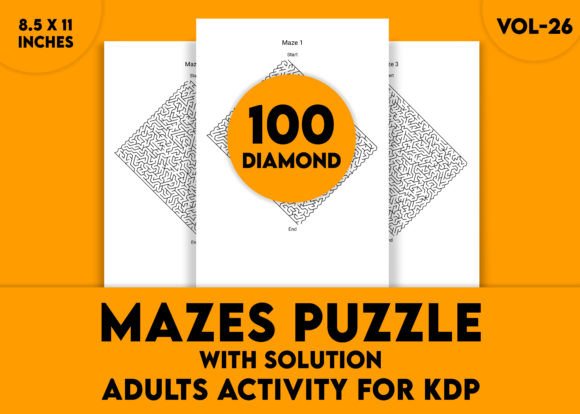
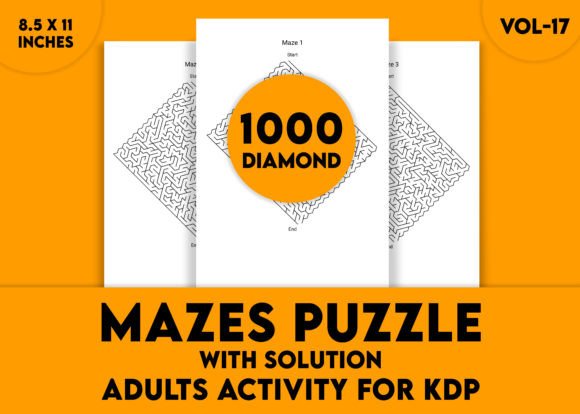
This volume contains one thousand diamond-shaped mazes, each printed on its own 8.5 x 11-inch page, with four solutions per page. The format is deliberate. Every maze demands sustained attention, spatial reasoning, and the ability to hold multiple possible paths in working memory while discarding dead ends. That process is not trivial. It requires the same kind of strategic thinking that goes into planning a campaign, structuring a deal, or debugging a complex system.
Why Diamond Mazes Demand a Different Kind of Thinking
Traditional rectangular mazes follow a familiar grid logic. The diamond shape in these puzzles introduces asymmetry and forces non-standard turns. You cannot rely on habitual scan patterns. Every twist, branch, loop, and barrier must be evaluated on its own terms. This trains the brain to adapt quickly to novel constraints—a skill that transfers directly to environments where standard operating procedures no longer apply.
The presence of multiple branches and loops means that a direct path rarely exists. You must test hypotheses, backtrack when they fail, and maintain composure when a promising route hits an obstacle. That is not unlike the experience of iterating on a product strategy or negotiating a multi-party agreement. The puzzle rewards patience, systematic elimination, and the willingness to abandon a favored path when evidence points elsewhere.
Strategic Use Cases for Entrepreneurs and Professionals
The value of Adults Hard Diamond Mazes Puzzles Vol-17 extends beyond personal enrichment. Used deliberately, it can support several professional objectives.
Reinforcing Decision-Making Discipline
Every maze presents a series of small decisions: turn left, go straight, try the lower branch. Each decision consumes time and attention, and each dead end carries a small cost. Over the course of a single puzzle, you make dozens of such choices. The cumulative effect is a workout in disciplined decision-making. You learn to recognize when to commit and when to pause, when to push forward and when to retrace. For entrepreneurs and managers who make high-volume decisions daily, this practice builds a habit of deliberate rather than reactive choice.
Improving Focus Under Constraints
The puzzles are large—one per page at 8.5 x 11 inches—which forces you to scan visually across a wide area while keeping the exit point in mind. That sustained visual attention is mentally demanding. In a world of constant interruptions, the ability to hold focus for even ten uninterrupted minutes is becoming a competitive advantage. Working through a maze trains that capacity in a measurable way. You know when you have solved it; the feedback is immediate and unambiguous.
Supporting Creative Problem-Solving
Loops and branches force non-linear thinking. You cannot simply move from start to finish in a straight line. You must explore, double back, and sometimes abandon the most obvious route. This mirrors the creative process in strategy, marketing, and product development. The best solutions often emerge after several failed attempts. The diamond maze format normalizes that experience in a low-stakes environment, making it easier to tolerate ambiguity in real-world projects.
When to Use These Mazes for Maximum Impact
Timing matters. The effectiveness of Adults Hard Diamond Mazes Puzzles Vol-17 depends on when and how you engage with it. Using it randomly between meetings will yield some benefit, but strategic scheduling amplifies the return.
Consider these moments:
- At the start of a focused work block. Spending five minutes on a maze before diving into a complex task can shift your brain into a deliberate mode. It acts as a cognitive warm-up, similar to stretching before physical activity.
- After a difficult decision. The act of solving a maze provides a structured mental reset. It engages a different part of your thinking while still requiring analytical processing. This can prevent rumination and help you approach the next challenge with fresh perspective.
- During a planning session. When you are mapping out a project timeline or a go-to-market strategy, the spatial reasoning involved in maze-solving can prime your brain to think in terms of paths, dependencies, and alternatives.
- As a deliberate break from screens. The puzzles are printed on paper. That alone is a strategic choice. Removing digital distraction for even a few minutes reduces cognitive load and allows your visual system to rest from blue light and constant notifications.
How to Approach the Puzzles with Intention
Not all maze-solving yields the same benefit. The key is to treat each puzzle as a deliberate practice exercise, not a race. Here are guidelines for getting the most out of the volume.
Set a Clear Goal Before You Start
Ask yourself what you want to accomplish in that session. Is it to improve speed? To practice patience? To test your ability to hold multiple paths in memory? Without a goal, you are simply passing time. With one, you are training a specific cognitive skill. Write the goal down if it helps. The act of articulating it changes how you approach the puzzle.
Use the Four Solutions Per Page as a Learning Tool
Each page shows four solutions. Do not look at them immediately. Solve the maze on your own first. Then review the provided solutions. Compare your path to the alternatives. Ask: Why did one route work better? Where did I get stuck? Were there clues I missed? This reflection turns a single puzzle into a feedback loop. Over one thousand puzzles, that loop compounds into significant improvement in spatial reasoning and strategic thinking.
Track Your Patterns
After ten or twenty mazes, you will notice tendencies. You might favor the right side, or tend to commit too early to a path. Recognizing these habits in the puzzle context can illuminate similar tendencies in your work. Do you always default to the same strategy? Do you abandon a line of inquiry too quickly? The mazes serve as a mirror for how you approach problems generally.
Practical Examples Across Different Roles
The same puzzle volume serves different purposes depending on the user's context. Consider how three different professionals might engage with it.
A marketing strategist uses the mazes to practice path analysis. When mapping a customer journey, multiple branches and loops exist just as they do in the diamond grid. Solving mazes trains the strategist to visualize alternative routes and anticipate where a user might get stuck. The barrier in a maze corresponds to a friction point in a funnel. The strategist learns to spot those barriers faster.
A software engineer uses the puzzles to strengthen debugging discipline. A maze is essentially a logic puzzle with a state space. The engineer learns to systematically eliminate possibilities, test assumptions, and recognize when to backtrack. That process transfers directly to tracing a bug through a codebase. The engineer who solves one thousand mazes will approach debugging with more patience and fewer emotional resets.
A small business owner uses the puzzles as a daily mental reset. Between managing operations, customer service, and finances, the owner faces constant pressure. A single maze provides a contained challenge that can be completed in a few minutes. It offers a sense of control and completion that may be scarce elsewhere. Over time, the cumulative practice in systematic thinking informs better decisions about resource allocation and process design.
Risks of Using the Puzzles Without Clear Goals
Like any tool, Adults Hard Diamond Mazes Puzzles Vol-17 can be misused. The most common risk is treating it as pure entertainment without reflection. Solving a maze and immediately moving to the next one without analysis yields marginal cognitive benefit. It becomes a passive activity rather than an active training session.
Another risk is using the puzzles as avoidance. If you reach for a maze every time a difficult task arises, you are training escape rather than endurance. The puzzles should be a deliberate part of your routine, not a substitute for doing hard work. Set boundaries around when and why you engage.
A third risk is focusing too heavily on speed. Racing through a maze may feel productive, but it undermines the strategic thinking the puzzle is designed to develop. Slow, methodical solving with attention to alternatives yields far more transferable skill. If you find yourself rushing, pause and reset your intention.
Long-Term Value and Cumulative Effect
One thousand mazes is not a small number. At one puzzle per day, the volume represents nearly three years of consistent practice. The cumulative effect is significant. Early puzzles will feel unfamiliar and slow. By puzzle two hundred, you will notice patterns in the maze design and in your own thinking. By puzzle five hundred, the process of scanning, testing, and backtracking will become more fluid. By puzzle one thousand, you will have developed a set of cognitive habits that apply far beyond the page.
Those habits include: systematic elimination of options, comfort with ambiguity, patience in the face of repeated failure, and the ability to hold multiple variables in working memory. These are not abstract benefits. They are practical skills that improve the quality of decisions, the depth of strategic thinking, and the efficiency of problem-solving in any professional domain.
Making the Decision to Invest in This Volume
Choosing whether to commit to Adults Hard Diamond Mazes Puzzles Vol-17 comes down to whether you value deliberate cognitive practice. If you believe that mental skills can be trained through structured repetition—just as physical skills are—then the volume offers a clear path. It is not a quick fix. It is a long-term investment in how you think.
Consider your current routine. Do you already set aside time for focused thinking away from screens? Do you have a method for training decision-making or patience? If the answer is no, this volume provides a simple and measurable starting point. The format is straightforward: one diamond per page, four solutions per page, no distractions. The only variable is your intention.
Approach it strategically. Use it when your mind needs warming up. Use it when you want to practice patience. Use it when you need a structured break that still engages your analytical faculties. And after each puzzle, take a moment to reflect on what the process revealed about your own thinking.
The mazes themselves are fixed. How you use them is entirely up to you. Used well, they become more than puzzles. They become a laboratory for how you approach complexity, uncertainty, and decisions—skills that matter long after the last maze is solved.