Sharpen Your Focus with Adults Hard Circle Mazes Puzzles Vol-32
Mazes have been a staple of problem-solving challenges for centuries, but the modern adult faces a unique set of cognitive demands. Between managing projects, making decisions, and juggling multiple responsibilities, the brain needs targeted exercise that goes beyond passive entertainment. Adults Hard Circle Mazes Puzzles Vol-32 delivers exactly that: a collection of 100 circular maze puzzles designed specifically for mature problem-solvers who want to engage their minds in a structured, repeatable way.
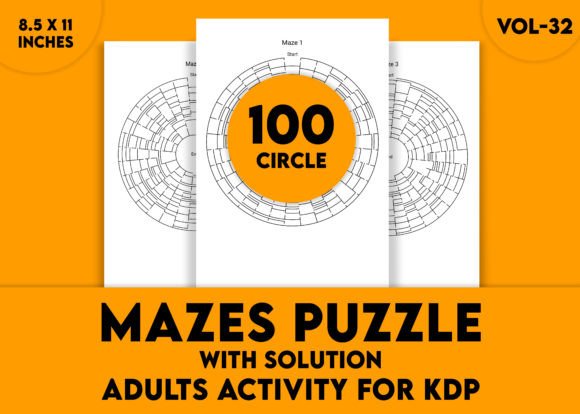
Each maze is printed on a standard 8.5x11 inch sheet, with one circle per page and four solutions per page for easy reference. The puzzles are not casual diversions. They feature multiple branches, loops, dead ends, and occasional barriers that require genuine spatial reasoning and strategic planning. This isn't a brain game you solve in thirty seconds. It is a tool for sustained mental engagement.
Where Circle Mazes Fit in a Real Workflow
Most adults do not have the luxury of long, uninterrupted blocks of time for cognitive training. The value of a resource like this lies in how easily it integrates into existing routines. Whether you are a freelancer between client calls, a project manager decompressing after a sprint review, or a creator looking to reset your attention before a deep work session, a single maze can serve as a focused transition activity.
Consider the following practical placements:
- Before a high-stakes task: Solving one maze primes your brain for pattern recognition and deliberate decision-making. It shifts your mental state from reactive to analytical.
- During a learning session: If you are studying a new skill or reviewing material, a short maze break can consolidate learning by giving your subconscious time to process information while your conscious mind navigates a different kind of problem.
- After a complex decision: Post-decision mental fatigue is real. A maze provides a low-risk, high-engagement activity that lets your brain reset without falling into passive scrolling or distraction.
The 8.5x11 inch format is deliberate. It fits standard binders, clipboards, and printer trays. You can print a handful of pages, keep them in a folder, and work through them over days or weeks. Because each page contains only one circle maze, there is no visual clutter. Your entire focus is on that single problem.
Understanding the Puzzle Structure
Adults Hard Circle Mazes Puzzles Vol-32 is not a random collection. Each maze follows a consistent layout: a circular boundary with an inner goal area. The path from the outer edge to the center (or vice versa) is obstructed by walls, branches, and loops. Some mazes include isolated sections that force you to backtrack, while others present multiple viable routes that require you to choose the most efficient path.
The four solutions per page allow you to verify your approach without frustration. If you get stuck, you can glance at the solution page to understand where your reasoning went wrong, then return to the maze with a clearer strategy. This feedback loop is essential for skill development. You are not just solving puzzles; you are building a mental model of how to navigate complex branching systems.
For professionals who work with decision trees, logic flows, or process mapping, these mazes offer a tactile way to practice the same kind of thinking. The loops and barriers mirror real-world obstacles like approval bottlenecks, resource constraints, or competing priorities. The practice of tracing a path while holding the overall structure in mind directly translates to better planning and execution skills.
Practical Implementation Tips
To get the most out of this collection, consider treating it as a deliberate practice tool rather than a casual pastime. Here are specific ways to integrate it into your routine:
- Set a timer. Allocate three to five minutes per maze. This forces you to make decisions under a mild time constraint, which mirrors real-world pressure. Over time, you will naturally improve both speed and accuracy.
- Use the editable PDF for repeated attempts. The fact that the file is editable means you can load it on a tablet or computer and trace paths digitally. Alternatively, print multiple copies of the same maze and see if you can solve it using a different route each time. This deepens your understanding of the maze's structure.
- Combine with other cognitive tools. Pair a maze session with a brief journal entry about a current problem you are facing. The spatial reasoning activity often sparks fresh insights because it activates different neural pathways than verbal or numerical thinking.
- Use it as a team warm-up. If you lead a team of creatives, marketers, or engineers, project a maze on screen and ask everyone to solve it independently. Compare approaches afterward. This exercise highlights different problem-solving styles and can improve team communication.
The 100-puzzle count is not arbitrary. It provides enough volume to track improvement over time. You can note how many mazes you solve within a week, which types of barriers slow you down, and whether your strategy changes as you progress. This kind of self-assessment is valuable for anyone committed to continuous improvement.
Compatibility with Broader Goals
This puzzle collection works well alongside other productivity and cognitive training methods. If you already use techniques like Pomodoro, deep work blocks, or mindfulness exercises, a maze can fill the transition period between focused sessions. It occupies the mind just enough to prevent rumination while allowing you to stay mentally active.
For educators and trainers, the mazes can be incorporated into workshops on problem-solving, decision-making, or systems thinking. The circular format is less common than rectangular mazes, which means participants cannot rely on familiar heuristics. They must adapt, which is itself a valuable learning experience.
Content creators and publishers will appreciate the clean, scalable format. The editable PDF allows you to resize, annotate, or embed the mazes into digital products, workbooks, or course materials. Because each maze is self-contained on a single page, you can easily excerpt individual puzzles for social media posts, email newsletters, or client handouts without reformatting.
Quality Control and Long-Term Use
Any tool you use repeatedly must hold up under consistent use. The mazes are designed with clear, high-contrast lines that print well on standard black-and-white printers. The 8.5x11 inch size leaves ample margin for note-taking or annotations. If you prefer to work on a screen, the editable PDF loads quickly and maintains resolution at any zoom level.
Over the course of 100 puzzles, you will encounter a range of difficulty levels. Some mazes can be solved in under a minute with a clear eye; others will require multiple attempts and careful planning. This variation prevents boredom and ensures that you are always slightly stretched. That stretch is where cognitive growth happens.
For long-term use, consider organizing the printed pages in a binder with dividers. Keep solved mazes in one section and unsolved ones in another. This gives you a physical record of your progress and makes it easy to revisit particularly challenging puzzles later. You may find that a maze that stumped you two weeks ago now feels straightforward. That is a concrete measure of improved spatial reasoning and patience.
Observations from Practical Use
One observation that emerges consistently among adult puzzlers is the shift in approach over time. Early attempts tend to be trial-and-error: you pick a direction and see where it leads. After several mazes, you naturally begin scanning the overall structure before committing to a path. You identify loops early, recognize dead-end branches, and anticipate barriers before reaching them. This is exactly the kind of strategic thinking that transfers to project planning, route optimization, and risk assessment.
Another observation is the role of frustration tolerance. The hard nature of these mazes means you will hit walls literally and figuratively. Learning to pause, assess, and try a different approach without abandoning the task is a skill that serves every professional. The mazes provide a safe environment to practice that resilience.
Finally, the circular shape adds an element rarely present in standard grid mazes: you must navigate without the crutch of corners and straight lines. Curves force continuous adjustment of your mental map. This is closer to how real-world problems unfold, with nonlinear paths and unexpected turns. The skills you build here are not abstract; they apply directly to navigating complex systems.
Making It Part of Your Routine
Integration is ultimately about consistency. You do not need to solve all 100 puzzles in a week. A sustainable rhythm might be one maze per day, perhaps at the start of your workday or during a dedicated break. Over three months, that is 90 mazes, which leaves you with a buffer for days when you want an extra challenge.
For those who prefer digital workflows, keep the editable PDF in your cloud storage and open it on your tablet during commutes or waiting periods. For those who favor analog, print a stack and keep them in your bag. The portability of the 8.5x11 format makes it easy to work anywhere.
If you share your workspace with others, the mazes can become a collaborative tool. Trade unsolved pages with a colleague and compare strategies afterward. This social dimension adds accountability and fresh perspectives. You might discover a solving technique you had not considered.
Final Thoughts on Process and Execution
Adults Hard Circle Mazes Puzzles Vol-32 is not a passive product. It is a structured exercise in focused attention, strategic planning, and iterative problem-solving. The 100 mazes, each on a single 8.5x11 page with four solutions for reference, provide a complete system for cognitive practice that fits naturally into a busy adult's life.
Whether you are a marketer mapping customer journeys, a developer debugging complex logic, or a freelancer balancing multiple projects, the mental habits you reinforce here translate directly to your work. The mazes do not replace other cognitive tools, but they complement them by offering a pure, low-stakes environment for practicing the kind of thinking that matters most: clear, patient, and adaptive reasoning.
Print a page. Find the center. Follow the path. Learn from the dead ends. Repeat. That simple loop, repeated over 100 variations, is one of the most practical investments you can make in your cognitive toolkit.