Mastering the Maze: A Strategic Approach to Adults Hard Hexagon Mazes Puzzles Vol-39
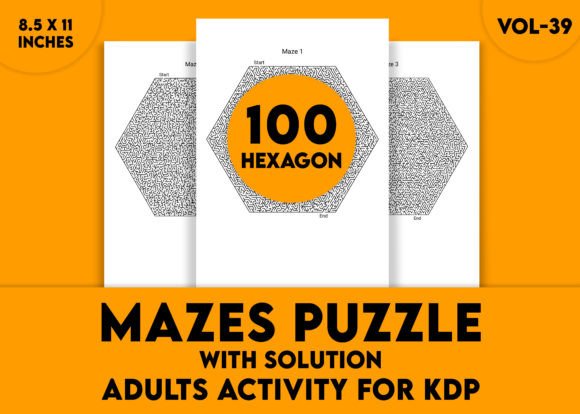
In a professional landscape defined by complex variables and high-stakes decisions, finding a low-pressure tool that systematically sharpens executive function is a rare advantage. The Adults Hard Hexagon Mazes Puzzles Vol-39 delivers exactly that. This collection is not a casual pastime; it is a structured cognitive resource designed for the adult mind. Featuring 100 distinct hexagon puzzles, each printed in a large 8.5x11 inch format, the volume is built for deep focus and analytical rigor. The inclusion of an editable PDF file, with four solutions per page, transforms a classic puzzle into a versatile workflow component that can be integrated into daily routines before, during, and after complex tasks.
Why Hexagons? The Geometry of Complex Thinking
The architecture of these puzzles is intentional. Unlike traditional square mazes that offer four directions of movement, hexagon mazes provide six. This geometric shift creates a dense network of branches, loops, and potential dead ends that closely mirrors the non-linear structure of real-world systems—whether it's a sales funnel, a project timeline, or a piece of code. The Adults Hard Hexagon Mazes Puzzles Vol-39 forces the solver to navigate high-density decision points, training the brain to hold multiple potential outcomes in working memory simultaneously.
Cognitive Demands and Professional Parallels
Solving a single maze in this collection requires planning, impulse control, and cognitive flexibility. You must preview a path, inhibit the urge to rush down a promising but ultimately wrong branch, and backtrack efficiently when you hit a barrier. This process directly parallels debugging a logic error, restructuring a content strategy, or navigating a negotiation. The format respects the user's time: one maze per page means no visual clutter, allowing you to immerse yourself fully in the problem. The editable PDF format ensures you can load this onto a tablet for a digital workflow or print a batch for an analog desk setup.
Strategic Integration: Before, During, and After Critical Work
A tool’s value is determined by how seamlessly it fits into existing processes. Here is how the Adults Hard Hexagon Mazes Puzzles Vol-39 functions across different phases of work and creative execution.
Pre-Project Priming (The Warm-Up Protocol)
Before launching into a high-cognitive-load task—such as drafting a contract, analyzing data, or designing a campaign—your brain needs activation. Spending 8 to 10 minutes on a hard hexagon maze shifts your neural state from passive to active. It engages the prefrontal cortex, specifically the regions responsible for spatial reasoning and strategic planning.
- Workflow Example: Open the editable PDF on your tablet or a printed copy. Set a timer for 10 minutes. Do not pressure yourself to finish; the goal is to enter a flow state of analysis. The large 8.5x11 inch page gives you ample room to trace potential paths with a stylus or pencil without feeling cramped.
- Outcome: You approach your main task with a warmed-up, pattern-ready mind, reducing the friction of starting deep work.
The Mid-Process Cognitive Reset (Structured Diffuse Thinking)
Every knowledge worker hits a wall. Whether it is writer's block, a stubborn spreadsheet, or a creative plateau, forcing conscious effort often yields diminishing returns. This is the ideal moment to deploy a maze. The puzzle serves as a "diffuse mode" catalyst, occupying your conscious focus just enough to allow your subconscious to process the original problem in the background.
Execution Tip: Keep the Adults Hard Hexagon Mazes Puzzles Vol-39 PDF in a readily accessible folder. When you feel the block, switch contexts immediately. Navigate the branches and loops of the maze for 15 minutes. The multiple branches and loops inherent in hexagon design encourage lateral thinking. Often, the solution to your work problem surfaces during this structured break. If you get stuck on the maze itself, the four solutions per page allow you to review the optimal path, providing a quick learning moment that reinforces decision-tree logic.
Post-Completion Cooldown (The Transition Ritual)
Finishing a major milestone can leave a cognitive residue that bleeds into the next task. A clear, goal-oriented activity with a definitive endpoint provides closure. Solving a maze from Volume 39 acts as a powerful reset. The single-page format (one hexagon per page) means you can physically file or close the document, creating a symbolic barrier between tasks.
- Implementation: After submitting a deliverable or completing a deep work session, pull up a new maze. Trace the path to completion. The satisfaction of finding the exit provides a micro-dose of accomplishment, clearing the mental palette for the next item on your agenda.
- Benefit: Reduces mental fatigue and improves focus over the course of a full day by preventing task bleed-over.
Practical Implementation and Workflow Mechanics
To maximize the return on investment from this puzzle volume, treat it as a resource that requires organization and intentional use.
Preparation and Asset Management
The editable PDF file ready format is the most flexible aspect of this product. Here is how to organize it for different environments:
- Digital Workflow (Tablet): Import the PDF into a note-taking application such as Notability, OneNote, or GoodNotes. Use a dedicated folder labeled "Cognitive Tools." Many apps allow you to duplicate pages, enabling you to solve a maze multiple times on separate layers. The large 8.5x11 size is perfect for a standard tablet screen without needing to zoom excessively.
- Analog Workflow (Print): Print a batch of 20 to 30 pages. Use a three-hole punch and store them in a binder. Use a fine-tip pen to solve. The physical act of drawing paths can be more grounding for some users, providing a tactile break from screen time.
- Batch Processing: Sort mazes by perceived difficulty or thematic complexity. Having a pre-organized stack removes the friction of selection when you need a quick cognitive shift.
The Two-Path Method for Skill Building
This is a quality control process for your own cognitive development. It involves solving the same maze twice with different constraints.
- First Pass (Exploration): Solve the maze with a pencil. Allow yourself to take wrong turns. Mark dead ends. Observe patterns in the layout.
- Second Pass (Optimization): After a brief pause, reload the same maze (using a fresh digital layer or a new printout). Using a pen, solve it again with the knowledge gained. Find the shortest, most efficient path.
This method mirrors the professional cycle of iteration and optimization. It trains your brain to shift from "getting it done" to "doing it efficiently." Over the course of 100 mazes, this builds a powerful habit of systematic improvement.
Using Solutions as Learning Data
The 4 solutions per page feature is not a shortcut; it is a feedback mechanism. After solving a maze—even if you are confident in your path—review the provided solution. Compare your route against the optimal one.
- Did you identify the correct branch early?
- Were there loops you could have bypassed?
- What was the decision logic of the optimal path?
This review phase is critical for long-term growth. It trains your pattern recognition for future mazes. You begin to see structural similarities across different puzzles, a skill that translates directly to identifying trends and efficiencies in business data, code architecture, or creative narratives.
Long-Term Applications for Professionals and Creators
The value of a 100-puzzle volume lies in its compound effect. Consistent engagement yields measurable improvements in specific cognitive domains.
For Project Managers and Team Leads
Resource allocation and risk management are essentially exercises in pathfinding. Navigating a hexagon maze reinforces the habit of evaluating multiple branches of a process before committing resources. It is a solitary drill that builds resilience in strategic thinking, helping you visualize complex workflows and anticipate bottlenecks before they occur.
For Entrepreneurs and Small Business Owners
Decision fatigue is a constant drain on entrepreneurial energy. The Adults Hard Hexagon Mazes Puzzles Vol-39 offers a low-stakes environment to exercise the decision-making muscle. Each branch requires a quick cost-benefit analysis. Practicing this in a puzzle format helps keep your strategic faculties sharp for real-world financial and operational decisions.
For Creators, Writers, and Marketers
Content funnels and customer journeys are rarely linear. They are complex systems of touchpoints, feedback loops, and drop-off points. Solving non-linear hexagon mazes trains the brain to think in terms of user flows. It enhances your ability to design content that guides an audience through a complex journey, anticipating where they might get lost and providing clear paths forward.
Consistency, Habit Formation, and Longevity
The true power of Volume 39 lies not in a single solve, but in the routine built around it. Here is how to ensure long-term use:
- Habit Stacking: Attach the puzzle to an existing daily habit. For example, "After my morning review of priorities, I will trace one path." Or, "Before I close my laptop for the day, I will complete one maze."
- Progressive Overload: With 100 puzzles, you will naturally progress. Track your solve time. As your spatial reasoning speed improves, the challenges remain high, ensuring you are consistently working at the edge of your ability.
- Low Friction Access: Keep the editable PDF on your desktop or a printed copy on your desk. The less effort required to start, the more likely you are to maintain the habit.
The Adults Hard Hexagon Mazes Puzzles Vol-39 is a practical, structured instrument for cognitive maintenance and improvement. It fits into the workflow of any adult who values deliberate practice, strategic thinking, and mental efficiency. Use it to prime your focus, navigate mental blocks, and close your work cycles with intention.