Mastering the Adults Hard Triangle Mazes Puzzle Vol-23: A Deep Dive into Cognitive Training and Spatial Logic
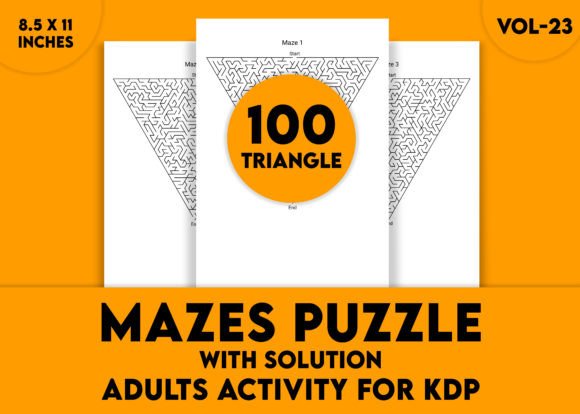
When most people picture a maze, they imagine a rectangular grid with squared-off corridors and dead ends. The Adults Hard Triangle Mazes Puzzle Vol-23 defies that expectation entirely. Instead of right angles and predictable paths, this puzzle book introduces a geometry that feels both foreign and intellectually refreshing. The triangular grid changes how your brain approaches navigation, forcing you to abandon the orthogonal thinking that you have relied on since childhood. What emerges is not just a puzzle book, but a targeted exercise in cognitive flexibility and spatial reasoning.
The decision to use triangular cells as the foundation for each maze fundamentally alters the problem-solving process. In a square grid, you have four possible directions to move at any given intersection. In a triangular grid, the number of potential paths expands to six, because each triangle shares edges with up to three neighbors, and the orientation of those edges allows for more nuanced movement. This increased complexity is not arbitrary; it requires you to hold more branching possibilities in your working memory at once. The Hard Triangle Mazes Puzzle Vol-23 leans into this property, creating puzzles that feel less like simple pathfinding and more like a three-dimensional logic puzzle reduced to two dimensions.
Understanding the Maze Architecture: Branches, Loops, and Barriers
One of the defining characteristics of this volume is the deliberate inclusion of structural features that force you to adapt your strategy. You will encounter branches that lead to promising corridors that turn out to be long loops, and loops that bring you back to a junction you visited minutes earlier. This is not a design flaw; it is a pedagogical tool. When you trace a line through a loop and return to your starting point, you are training your brain to recognize spatial relationships that are not immediately obvious. You learn to hold a mental map of the maze without relying on external notes, a skill that translates directly to improved spatial awareness in daily life.
The obstacles and barriers mentioned in the puzzle description add another layer of sophistication. In a standard maze, every wall is a dead end. In a triangular maze, barriers can appear as partial walls that block only one side of a triangle cell, forcing you to approach the same cell from a different orientation. This subtle change means that you cannot simply memorize a path; you must also consider the angle of approach. For example, a barrier might block the top edge of a triangle but leave the bottom two edges open, meaning you can pass through the cell only if you enter from a specific direction. This dynamic interaction between barrier placement and triangle orientation creates puzzles that require constant reassessment of your route.
The Physical Format: Why the 8.5 x 11 Inch Page Matters
Printing each maze on a single sheet of paper at 8.5 by 11 inches is a deliberate choice that directly affects the solving experience. When a maze occupies a full page, the triangular cells are large enough that you can trace paths with a fine-tipped pen or pencil without feeling cramped. This is especially important for adults who enjoy detailed, intricate work. The large format also reduces eye strain, allowing you to spend longer periods immersed in a single puzzle without losing track of your progress. For educators and therapists, this size is practical: the maze can be photocopied or scanned without losing resolution, and the one-per-page layout makes it easy to distribute individual puzzles to groups without cutting or folding.
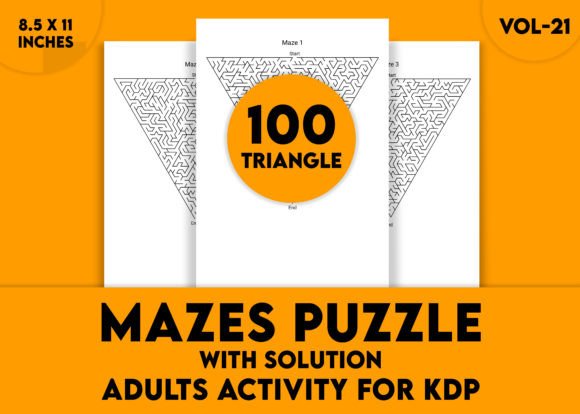
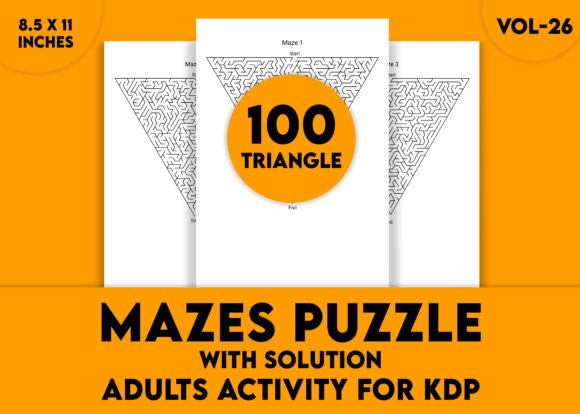
Each page presents exactly one triangle, which in this context refers to one maze based on a triangular grid. The decision to place a single puzzle per page, while leaving room for multiple solutions printed elsewhere (four solutions per page at the back of the book), is a thoughtful design choice. You can attempt a maze, check your answer, and then return to the same page the next day to try again, because the solutions are kept separate. This format also makes the Adults Hard Triangle Mazes Puzzle Vol-23 a reusable resource: if you use a pencil, you can erase your path and solve again, or you can photocopy the page before starting.
Who Benefits from Hard Triangle Mazes? A Cross-Section of Users
The audience for this puzzle book extends far beyond casual hobbyists. Professionals in fields that require strong spatial reasoning—such as architects, urban planners, engineers, and graphic designers—can use these mazes as a form of mental warm-up before tackling complex design problems. The triangular grid mimics the triangulation used in computer graphics, terrain modeling, and structural engineering, making the activity directly relevant to those who work with spatial data.
Researchers and educators in cognitive science find value in the structured difficulty of these puzzles. Because the mazes are designed to be challenging for adults, they provide a consistent stimulus for studying problem-solving strategies, working memory capacity, and decision-making under uncertainty. The presence of loops and branches presents a controlled environment for studying how people develop heuristics—like always turning left or always avoiding previously visited cells—and how they break out of those heuristics when faced with a dead end.
Business owners and managers who want to promote mental agility in their teams can incorporate these puzzles into workshops or break rooms. Solving a series of hard triangular mazes requires sustained attention, pattern recognition, and the ability to tolerate frustration—all skills that are valuable in high-pressure work environments. The editable PDF format noted in the product features means that you can annotate the mazes digitally, share them with remote teams, or even modify the puzzles to create custom variations for specific training goals.
Problem-Solving Strategies Unique to Triangular Mazes
Solving a triangular maze effectively requires a slightly different toolkit than what works for square-grid puzzles. One common approach that many adults develop is the "boundary trace" method: because the maze is enclosed by a perimeter, you can sometimes locate the exit by following the outer edge. However, in triangular mazes, the perimeter is made of angled segments, and the exit might be positioned along any side. A better strategy involves using the orientation of the triangles as landmarks. Note whether a given triangle points upward or downward—this orientation changes the connectivity of adjacent cells. An upward-pointing triangle shares its three edges with three downward-pointing triangles, and vice versa. Recognizing this alternating pattern helps you build a mental grid that is more systematic than a simple path sketch.
Another practical technique is to treat each branch as a decision node. When you encounter a junction with three or more possible exits, lightly mark the junction point and then explore one path, keeping a mental note of the others. If you hit a dead end or a looping corridor, return to the junction and cross off the failed option. This systematic elimination, combined with the visual feedback of the large page format, turns the solving process into a methodical exercise that feels more like debugging a program than wandering a maze. Over time, you develop an intuitive sense for how barriers and edges interact, and your solving speed improves not because you memorize solutions, but because your brain becomes more efficient at processing angled spatial information.
Real-World Relevance: Beyond the Page
Engaging with hard triangular mazes has real-world cognitive benefits that extend into everyday tasks. Spatial reasoning is a critical component of navigation, whether you are driving through an unfamiliar city or arranging furniture in a room. By practicing with a triangular grid, you train your brain to handle non-right-angle layouts, which are actually more common in nature and in organic city development than perfect grids. The ability to visualize routes that involve diagonal movements and angled turns improves your capacity to read maps, assemble flat-pack furniture, and even understand complex data visualizations like treemaps or Voronoi diagrams.
Furthermore, the frustration tolerance built by repeatedly attempting puzzles with loops and barriers fosters a growth mindset. You learn that a dead end is not a failure but a piece of information that clarifies the correct path. This perspective is directly applicable to professional problem-solving: in design, engineering, or business strategy, understanding what does not work is often as valuable as finding the one solution that does. The Adults Hard Triangle Mazes Puzzle Vol-23 provides a low-stakes environment to practice this mindset without the pressure of real-world consequences.
Formatting and Accessibility: The Editable PDF Advantage
The mention of an editable PDF file is not a minor detail—it fundamentally changes how the puzzles can be used. With an editable PDF, you can solve the maze on a tablet or computer using a stylus or mouse, and then save your work for later review. This is particularly useful for educators who want to distribute puzzles digitally and collect them for grading, or for hobbyists who prefer to keep a digital archive of their completed puzzles. You can also adjust the zoom level to focus on a specific region of the maze, which is harder to do with a physical book. The ability to edit the PDF also means you can erase your progress digitally, making the puzzles fully reusable without printing multiple copies.
The four-solutions-per-page feature at the back of the book is designed to conserve space while still providing a clear reference. Each solution page contains four completed maze paths, typically arranged in a grid. When you check your solution, you compare your drawn path to the printed solution. Because each maze is printed on its own page, you can flip to the solution section without losing your place. This layout also makes it easy to verify your answer without accidentally seeing the solution to the next puzzle, as each solution is clearly labeled with the corresponding puzzle number.
Why Hard Triangle Mazes Are Gaining Popularity Among Adults
In recent years, there has been a notable shift in the puzzle market toward challenges that are specifically designed for adults. The rise of adult coloring books, complex jigsaw puzzles, and logic-puzzle apps indicates a broad desire for activities that are mentally demanding without being work-related. Hard triangle mazes fit into this trend perfectly. They offer a pure cognitive challenge that does not depend on external knowledge, vocabulary, or trivia. You do not need to know any facts or figures to succeed; you only need your spatial reasoning skills and persistence.
The triangular format adds novelty that keeps the experience fresh. Many adults who have solved hundreds of square mazes over a lifetime find that triangular mazes feel like a completely new genre. The initial disorientation—trying to trace a path and realizing that your usual mental shortcuts do not work—is part of the appeal. It engages the brain in a way that routine puzzles no longer can. This novelty is enhanced by the difficulty level: Adults Hard Triangle Mazes Puzzle Vol-23 is not for beginners, so solvers know they are being challenged at a level appropriate for their skills.
For creators and hobbyists who enjoy designing their own puzzles, studying the patterns in this book can inspire new maze designs. The way obstacles are placed, the frequency of loops, and the integration of multiple branches follow certain patterns that can be reverse-engineered and adapted. This makes the book not just a collection of puzzles to solve, but also a reference for understanding the mechanics of triangular maze design.
Practical Considerations for First-Time Solvers
If you are opening the Adults Hard Triangle Mazes Puzzle Vol-23 for the first time, adopt a few simple habits to maximize your experience. Use a pencil with a fine tip—mechanical pencils with 0.5 mm or 0.7 mm leads work well because they won't obscure the cell boundaries. Work in a well-lit area, and consider rotating the page to align the grid with your dominant hand's orientation. Some solvers find it helpful to use two fingers to trace the path while drawing, one finger on the current cell and one on the goal, to maintain spatial awareness of both your position and your destination.
Do not expect to complete a maze in one sitting. These puzzles are designed to be hard, and it is common to spend twenty to forty minutes on a single maze, especially the later ones. Taking a break and returning to the puzzle with fresh eyes often reveals a path that was invisible when you were staring at the page for too long. This kind of spaced problem-solving is actually beneficial for memory consolidation and pattern recognition, so do not rush. The experience of stepping away and coming back to find the solution more clearly is itself a valuable cognitive skill to develop.
Finally, use the solution pages as a learning tool, not as a crutch. When you look at a solution, study the path carefully. Notice which branches were ignored, which loops were avoided, and how the solver navigated around barriers. Understanding why a particular path works, rather than just seeing that it works, will improve your ability to solve the next maze on your own. Over the course of the 100 mazes in this volume, your solving approach will evolve, and you will likely find that the first few puzzles feel much harder than the last few, not because the later ones are easier, but because your brain has adapted to the triangular logic.
Looking Ahead: The Future of Geometric Puzzle Design
The popularity of hard triangular mazes hints at a broader trend in puzzle design: a move away from purely recreational puzzles toward tools that deliberately target cognitive skills. As our understanding of brain plasticity grows, more designers are creating puzzles that exercise specific mental faculties—working memory, spatial rotation, logical deduction, and inhibitory control. Triangular mazes are particularly well-suited for this purpose because they combine all of these faculties in a single activity. You must remember where you have been (working memory), imagine how a barrier changes connectivity (spatial rotation), evaluate multiple candidate paths (logical deduction), and resist the urge to guess randomly (inhibitory control).
Volumes like the 23rd edition of a series indicate that there is ongoing demand for new content at this difficulty level. Each volume can introduce variations in obstacle placement, loop density, or the shape of the overall maze boundary. The 100 mazes in this single volume provide enough material for months of regular practice, making it a sustainable resource for anyone serious about cognitive maintenance or improvement. Whether you are a professional looking to sharpen your analytical skills, an educator seeking engaging classroom materials, or simply an adult who enjoys a good mental workout, the Adults Hard Triangle Mazes Puzzle Vol-23 offers a targeted, satisfying, and genuinely challenging experience that rewards persistence and strategic thinking. The journey through each triangular grid is not just about finding the exit—it is about discovering how your own mind navigates complexity.