Adults Hard Hexagon Mazes Puzzles Vol-77 – A Structured Challenge for Cognitive Workflow
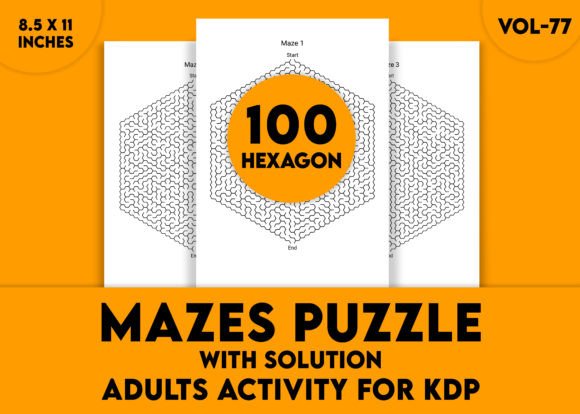
Problem-solving is not a single event. It is a cycle of planning, testing, adjusting, and executing. In professional and creative environments, the ability to navigate complexity directly affects output quality. Adults Hard Hexagon Mazes Puzzles Vol-77 offers a unique analogue tool for practicing this cycle. It is not simply a collection of puzzles. It is a structured system for developing spatial reasoning, pattern recognition, and decision-making under constraints. Each page presents one hexagon maze with multiple branches, loops, and barriers that require deliberate navigation. The format is deliberate: one maze per page, four solutions per page layout, and a large 8.5 x 11 inch sheet that gives you room to plan your route before committing ink to paper.
This volume fits into a broader process of deliberate cognitive training. Whether you are a marketer mapping a campaign funnel, an educator designing a lesson sequence, or a freelancer managing multiple project streams, the same underlying logic applies. You enter a system, you encounter forks, you backtrack when a path dead-ends, and you ultimately find a route that works. Adults Hard Hexagon Mazes Puzzles Vol-77 is a sandbox for this exact mental motion.
Where This Puzzle Volume Fits Into Your Workflow
The value of a hard maze is not in the solution itself. It is in the process you follow to reach it. When you sit down with a hexagon maze from this volume, you engage in a sequence that mirrors many real-world tasks:
- Orientation: You scan the entire maze. You note the start point, the endpoint, and the general structure of the walls and loops. This is analogous to reviewing a project brief or a dataset before diving into execution.
- Route planning: You mentally trace possible paths. Some branches look promising. Others lead to dead ends. You make a preliminary choice based on incomplete information. In a work context, this is the strategic phase — you decide which direction to pursue before you commit resources.
- Execution and adjustment: You begin solving. When you hit a barrier, you do not abandon the entire puzzle. You return to the last viable junction and try another path. This is the iterative loop of testing, feedback, and revision that defines effective project management and creative development.
- Completion and reflection: After solving, you review the correct path. You consider which assumptions led you into dead ends and which observations helped you find the right route. This reflective step strengthens your ability to recognize patterns in future challenges.
This sequence makes Adults Hard Hexagon Mazes Puzzles Vol-77 a practical tool for professionals who need to sharpen their decision-making under pressure. It is not a passive entertainment. It is an active exercise in process management.
Using the Mazes Before, During, and After a Task
The flexibility of this puzzle volume lies in how you can integrate it at different points in your work cycle. It is not a one-position tool. Each placement serves a different purpose.
Before a project: Priming your cognitive system
Starting a complex task with a clear mind is rare. Distractions, mental fatigue, and lingering concerns from previous work all reduce focus. Working through one hexagon maze before you begin can shift your brain into a problem-solving state. The puzzle acts as a warm-up. It forces you to concentrate on a single spatial problem, which activates the same neural circuits you will use for analysis, planning, and execution. After ten or fifteen minutes with a hard maze, you enter your actual work with sharper attention and a more deliberate approach.
During a task: A structured break for mental reset
Extended work sessions suffer from diminishing returns. After a certain point, your ability to evaluate options and catch errors drops significantly. A short, structured break that involves a completely different type of problem can restore cognitive function without pulling you out of a productive mindset. Solving a hexagon maze from this volume during a break gives your mind a focused reset. You are still solving, still analyzing, but the context is different. When you return to your primary task, you see it with fresh eyes.
After a task: Consolidating insights and decompressing
Completing a significant piece of work often leaves you with residual mental energy that is hard to shut off. A maze session after a task allows you to channel that energy into a low-stakes challenge. It also reinforces the problem-solving patterns you used during your work. The loop of trial, error, and adjustment becomes more automatic the more you practice it. Adults Hard Hexagon Mazes Puzzles Vol-77 provides a consistent format for this post-task practice, with enough variety across one hundred mazes to keep the exercise fresh.
How This Volume Interacts with Other Tools and Methods
A hard maze puzzle does not exist in isolation. It interacts with your existing workflows, tools, and mental models in several ways:
- Digital planning tools: If you use task managers, whiteboards, or mind-mapping software, the maze-solving process can complement your digital planning. The physical act of tracing a path with a pen on large-format paper engages kinesthetic learning and memory differently than clicking and dragging. Alternating between digital planning and paper-based mazes can improve your overall spatial reasoning and workflow design.
- Journaling and reflection systems: Many professionals keep a daily or weekly journal to track decisions and outcomes. After solving a maze, you can note which strategies worked and which did not. Over time, you build a personal library of problem-solving patterns that you can apply to non-puzzle challenges.
- Team or collaborative settings: In small teams, educators, or groups of creators, sharing puzzle sessions can align thinking styles. Working through the same maze individually and then comparing your paths reveals different approaches to the same problem. This is directly applicable to brainstorming sessions, strategy meetings, and process improvement discussions.
- Time management frameworks: Pairing maze sessions with methods like the Pomodoro technique, time blocking, or deep work protocols creates a structured practice. For example, you can use one maze as a focused activity within a 25-minute block, then review the solution pattern as part of your break reflection.
Practical Implementation Tips for Integrating the Mazes Into Your Routine
Getting value from Adults Hard Hexagon Mazes Puzzles Vol-77 is not about solving all one hundred mazes as fast as possible. It is about intentional practice. Here are specific ways to integrate the volume smoothly into your work or personal routine:
- Set a consistent trigger. Choose a specific time of day or a specific trigger event for your maze session. For instance, solve one maze before checking email in the morning, or after completing a major deliverable. Consistency removes the decision of when to practice.
- Use the large format deliberately. The 8.5 x 11 inch page size is not arbitrary. Use a pen with a fine tip and trace your path slowly. The physical space allows you to see the entire maze structure at once, which encourages you to plan before moving. Do not rush. The point is the process, not the finish.
- Review both correct and incorrect paths. After checking the solution page, look at the dead ends you explored. Ask yourself: What told me that path was worth trying? What subtle visual cue made me turn back? This review strengthens your ability to read complex layouts in real time.
- Rotate between mazes. Do not solve all mazes from the same section in one sitting. Spread them out. Each maze has its own configuration of branches, loops, and barriers, and your brain benefits from varied challenges. The volume includes one hundred distinct puzzles, so you have plenty of material for long-term rotation.
- Pair with a physical or digital timer. If you want to train speed under pressure, set a timer for each maze. If you want to train depth and accuracy, remove the timer entirely and solve slowly. Both approaches are valuable, and the same puzzle works for either mode.
Preparation, Usability, and Long-Term Use
The volume is designed as an editable PDF file, which gives you flexibility in how you access and use it. You can print directly on standard letter-size paper, or you can load the file onto a tablet and solve digitally with a stylus. The four-solutions-per-page layout means you can check your work without flipping back and forth through separate answer sections. This organization reduces friction and keeps you in the solving flow.
For long-term use, consider building a small practice kit. Keep a printed stack of mazes, a dedicated pen, and a notebook for reflection notes in one physical location. When you finish a maze, date the page and note any observations about your solving approach. Over weeks and months, you will see which types of hexagon patterns consistently give you trouble and which you have learned to navigate quickly. This meta-awareness is one of the most valuable outcomes of consistent practice.
Compatibility is straightforward. The editable PDF works across major platforms — Windows, macOS, iOS, Android, and Linux. You do not need special software beyond a standard PDF reader. The large 8.5 x 11 inch format prints cleanly on any home or office printer, and the maze lines are clear and well-defined. There is no loss of detail when printing at full resolution.
Sustaining Consistency and Quality Over Time
Any tool is only as effective as your willingness to use it consistently. Adults Hard Hexagon Mazes Puzzles Vol-77 is structured to support regular practice without overwhelming you. With one hundred mazes, you have enough material for three months of daily practice with room for rest days. The difficulty level is calibrated for adults, so each maze requires genuine effort. You will not outgrow the volume quickly, and you can always return to earlier puzzles to see if your approach has improved.
Quality control is built into the design. Each maze has a single valid solution, which is printed clearly in the solutions section. The barriers, loops, and multiple branches are positioned to create challenging but solvable layouts. You will encounter dead ends that test your patience and junctions that require careful evaluation. The puzzles are not random. They are constructed to exercise specific cognitive skills: scanning ahead, holding multiple possibilities in memory, and making decisions under uncertainty.
For educators, trainers, and facilitators, this volume can serve as a consistent activity for workshops, team-building sessions, or classroom warm-ups. The one-per-page layout makes it easy to distribute, and the large format ensures that participants have room to work. You can use the mazes as discussion prompts for problem-solving strategies, decision-making biases, or process improvement metaphors.
Final Observations on Integration and Execution
The gap between knowing how to solve a problem and actually solving it is bridged by practice. Adults Hard Hexagon Mazes Puzzles Vol-77 provides a structured, repeatable, and progressively challenging environment for that practice. It is not a gimmick. It is a straightforward tool that you can integrate into your existing routines with minimal overhead. The format respects your time — one maze per page, clear solutions, large printable area — so you can focus entirely on the cognitive work.
Whether you use it as a pre-project warm-up, a mid-task break, or a post-task reflection tool, the volume rewards deliberate engagement. The hexagon layout introduces a level of complexity beyond standard rectangular mazes, and the multiple branches and loops ensure that you cannot solve on autopilot. You must think, adjust, and persist. Those are the same habits that drive effective work in any professional or creative field.
Print the first maze. Take a slow look at the structure. Plan a route, then trace it. If you hit a dead end, return to the last solid junction and try again. That process, repeated one hundred times with increasing nuance, is where the real value lives. Good luck and have fun.